Skyrim is a fantasy role-playing game in which you guide a character through a world of towns, wilderness and ancient ruins. The Dwemer are a vanished civilisation whose buildings, machines and everyday belongings remain within that world. A Dwemer bowl is one such object: a small metal vessel that your character can pick up, sell or keep. The inventory is the game’s menu listing what that character is carrying.
Consider the journey of a Dwemer bowl. In a ruined chamber, it belongs to an arrangement: a surface, a room, the remains of a civilisation. In the inventory, it becomes a name accompanied by weight and value. On a shelf at home, it can acquire another significance entirely. It is the bowl you decided to keep.
This is an imagined itinerary through Skyrim’s systems, rather than a record of a particular play session. Its familiarity comes from the ordinary actions it connects. An object can pass from scenery to possession so quickly that the change hardly registers. The room continues to look ancient. The bag becomes a little heavier.
Yet something substantial has happened. An object that helped establish the existence of a world beyond the player has entered the player’s account of that world. What belonged to an atmosphere can become evidence of a visit, a contribution towards the next purchase, or a small improvement to the house.
Skyrim gives this transition unusual emotional range. Its ruins encourage wonder at the scale of what has disappeared. Its objects offer the satisfaction of making some fragment of that disappearance manageable. You can emerge from an encounter with the incomprehensible carrying something that fits on a table.
The pleasure deserves to be taken seriously. A collection can give a journey continuity. An old weapon can remember something its statistics no longer express. But keeping also changes the terms of attention. A landscape that seemed to exceed you can gradually become a distribution of things you have acquired and things you have yet to find.
Following that movement, from ruin to inventory to home, reveals a tension at the centre of inhabitable game worlds. They invite us to feel that they exist independently of us, while making their contents available for our use. How much of belonging grows through that availability, and how much requires allowing a place to remain beyond our possession?
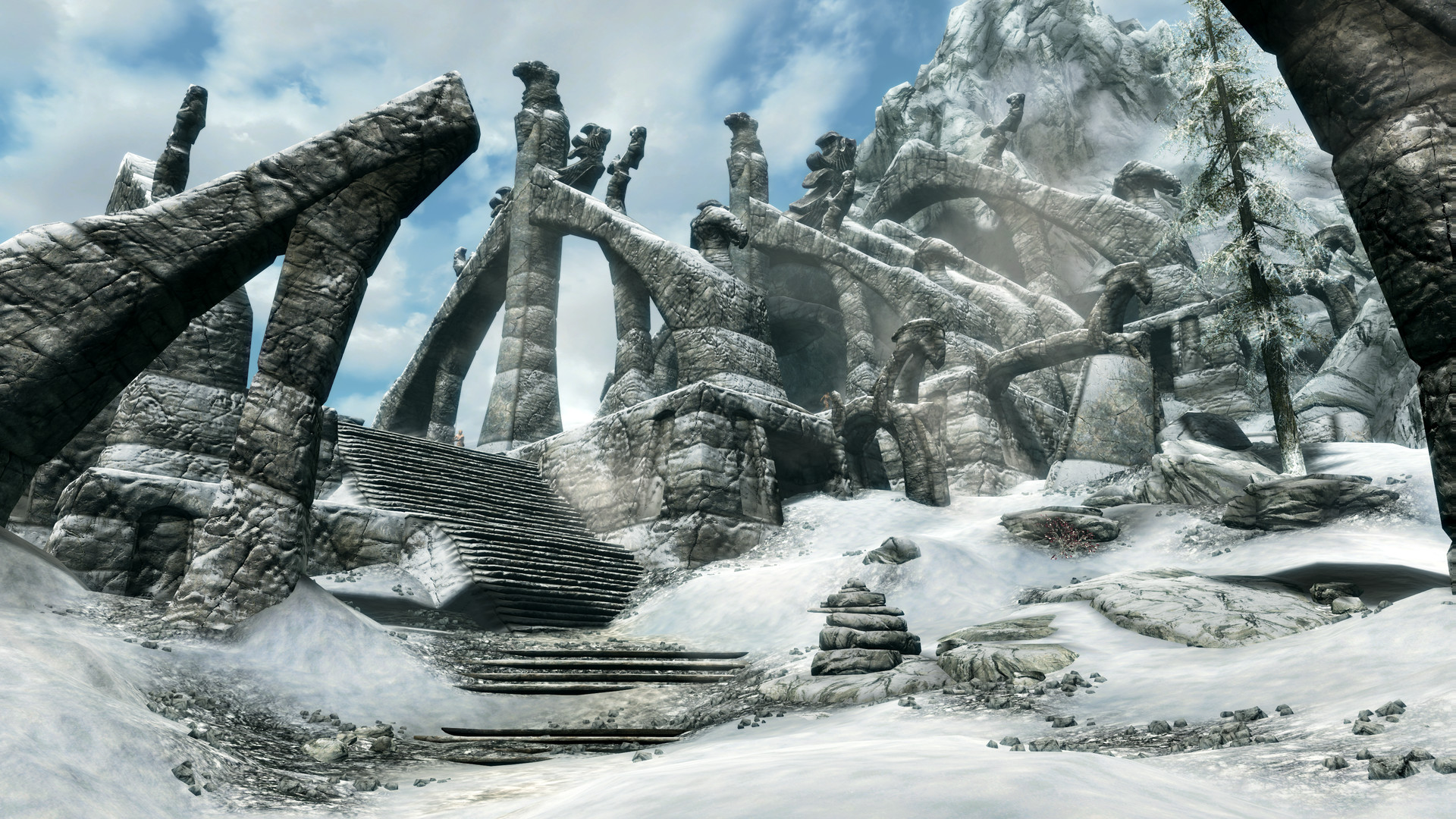
Arriving after everyone else
The ruin is a particularly effective way to make a fictional world feel older than its visitor. A broken structure implies a sequence that the player has not witnessed: construction, occupation, alteration, abandonment. Much of that sequence can remain unspecified. The visible remainder supplies enough information for the imagination to begin working backwards.
Henry Jenkins describes game environments as spaces capable of embedding narrative information. Their arrangements can give players material from which to reconstruct events, making exploration part of interpretation.1 In Skyrim, this offers a way to understand why a room can matter before its contents become useful. Architecture establishes relations between objects. A vessel beside a place to sit suggests a different history from the same vessel isolated in a corridor.
The player need not solve that history for the setting to have force. Indeed, partial understanding can sustain the impression that the place has more to it than the immediate task. A doorway promises further space. A mechanism suggests knowledge someone once possessed. The world appears to retain interests that do not begin with the player’s arrival.
Markarth complicates the idea that the past survives only in abandoned dungeons. Its Dwemer architecture has been inhabited again; Understone Keep serves as a castle while also accommodating Calcelmo’s archaeological work and museum. Contemporary government, research and older construction occupy connected spaces.2 History is therefore available through reuse as well as discovery. People can live within structures whose original makers are gone.
This matters because the scenic category of the ruin can make an occupied world appear empty. A visitor sees an evocative remnant and overlooks the people whose present has formed around it. Markarth’s contested political life makes that simplification especially difficult. Being late to a place does not make everyone already there part of the background.
The distinction between types of ruin also deserves attention. A Nordic burial chamber and a Dwemer complex offer different accounts of the past. Collapsing them into the same convenient category of dungeon can obscure the uses suggested by their architecture. Progress asks whether a space can be crossed. Interpretation asks what kind of space is being crossed, and what the crossing changes.
A civilisation with a resale value
Open the inventory and another description becomes available. Prima’s Skyrim inventory reference lists a Dwemer bowl with a weight of two and a base value of twenty. These figures describe game properties; they are not an account of its cultural importance, and the value is not a guaranteed sale price.3
The numbers are useful. They help the player make decisions within a carrying limit. Their usefulness is precisely what makes the translation interesting. The object can now be considered alongside things with which it shared no relationship in the room where it was found. A vessel and a weapon compete for the same finite capacity.
Igor Kopytoff’s account of the cultural biography of things provides a vocabulary for this change. Commodity status, he argues, is culturally assigned and can change over an object’s life. Something treated as exchangeable in one situation may be treated differently in another.4 An object’s significance does not reside permanently in the number attached to it.
Applied to Skyrim, that distinction allows us to follow an item without assuming that one description cancels all the others. The bowl can be economically unremarkable and personally irreplaceable. Another player can sell an identical bowl without having overlooked its proper meaning. The interesting subject is the decision through which an interchangeable item becomes this particular thing worth keeping.
The inventory nevertheless changes what is easy to know. It provides a legible account of the object’s usefulness while detaching it from the spatial relationships that first surrounded it. The system can name the thing without preserving the exact quality of the encounter. A difficult approach, an unexpectedly quiet room, the reason for looking down: these may survive chiefly in the player’s recollection.
Acquisition can therefore preserve one kind of evidence while weakening another. You retain the object. You may forget why it mattered. Conversely, a modest item can become the means through which an otherwise unrecorded moment remains accessible. Nothing in the inventory’s numerical description decides which outcome follows.
The world is not simply diminished by being made usable. Use is one way of becoming involved in it. The tension appears when a useful description becomes exhaustive, and everything encountered is read chiefly in terms of what can be taken away.
One bowl in three contexts
Editorial comparison. The setting and shelf are imagined; this is not a recorded object journey. Weight and base value follow note 3.
| Context | What comes forward | What recedes |
|---|---|---|
| In the ruin | An object among other objects | Its individual history may remain unknown. |
| In the inventory | Weight 2 · Base value 20 | The room and its arrangement are no longer visible. |
| On your shelf | The bowl you chose to keep | Its earlier relationships depend partly on what you remember. |
The claw that has somewhere else to go
Skyrim also supplies an early objection to any argument that treats finding as an automatic entitlement to keep. The Golden Claw has been stolen from the Riverwood Trader. Its quest sends the player to recover it and eventually return it to Lucan Valerius. Along the way, the claw functions as a key; the symbols on its palm supply a puzzle solution.5
Within that sequence, the inventory can support close attention. Rotating the object reveals information that looking at it casually might miss. Handling is part of understanding. The interface that separates an object from its surroundings can also make its details available for examination.
The claw’s return places a further limit on the acquisition story. The quest recognises a destination beyond the player’s home. Success can involve giving something back. That does not resolve every question about where an ancient object originally came from, but it establishes a clear relationship within the immediate narrative: another person has a claim the player is asked to acknowledge.
The distinction makes the wider argument more precise. Skyrim contains several relationships to objects, and they are not interchangeable. Recovery, purchase, theft and reward carry different narrative meanings, even when all involve moving something into the same inventory.
What deserves examination is how those differences remain visible after the moment of acquisition. A collection organised around the collector’s achievement may remember that an object was difficult to obtain while giving less attention to why it was elsewhere, who wanted it, or whether keeping it was the purpose of the encounter. The Golden Claw offers a small but consequential reminder that a satisfying object story can end outside our possession.
Bringing the outside in
The home gives these decisions somewhere to accumulate. Bethesda’s description of Hearthfire, an official Skyrim add-on, moves from acquiring land to constructing a house and furnishing it with spaces for particular activities.6 It makes a distinction the larger world can also sustain: being able to enter a place and being able to arrange a life there are different kinds of involvement.
A home changes the significance of an expedition’s return. The journey has produced material that can enter an enduring arrangement. What is kept together begins to describe a character: a reader, a craftsperson, someone unable to dispose of anything associated with an earlier adventure. These are possible interpretations of a room, not reliable diagnoses of the person playing.
Russell Belk’s account of possessions and the extended self argues that objects can contribute to identity and continuity.7 It offers a useful starting point for understanding why retaining something need not depend on practical advantage. Applied here, the connection is interpretive. A digital sword can matter because it participated in a history of play, even after a stronger sword makes it redundant in combat.
Display adds selection. The room can bring together things separated by geography, historical period and original purpose. Their new relationship may be the order in which they were encountered, or the story the player wants the character to inhabit. The collection makes another world inside the larger one.
That smaller world can also omit the conditions of its making. A pleasing arrangement does not automatically disclose how its contents arrived. A trophy is particularly efficient in this respect: it makes an event visible through an object while allowing the event to contract around the achievement of its possessor.
Yet the shelf can remain tender as well as self-congratulatory. There is a difference between displaying a valuable thing to demonstrate success and keeping an ordinary thing because it carries an association. Both are acts of selection. Their meanings depend on what the player attends to, remembers and allows the object to retain.
The house offers no final settlement between care and acquisition. It makes their coexistence visible. An object can be cherished within a new arrangement while something about its earlier place becomes harder to recover.
When the collection becomes a museum
Legacy of the Dragonborn gives that arrangement an institutional form. The community-made expansion adds the Dragonborn Gallery in Solitude, alongside quests, an explorers’ society and a home. Its creators describe a museum that displays artefacts and records where the player has been and what they have accomplished.8 This is a feature of the mod, distinct from Bethesda’s base game and official expansions.
A gallery can turn a dispersed playthrough into a place that can be walked through. Events acquire neighbours. Objects previously encountered hours apart become available to view together. The collection offers a spatial memory of play, with the appeal of making a long and fragmented experience perceptible as a whole.
It also changes the direction in which significance travels. A journey can produce an object worth displaying. Once collecting becomes a purpose, the desire to complete a display can produce the next journey. The museum can make the landscape newly interesting while giving that interest a particular shape: what remains to be found for here?
An empty space can sharpen curiosity. It can also make an encounter feel unfinished until something has been brought back. The distinction cannot be decided from the presence of a display system alone. It depends on how that system enters a person’s play. A collection may encourage close reading or become a list against which places are efficiently processed.
Calcelmo’s Dwemer Museum provides a useful comparison within the original game. Prima’s guide presents it as a collection recovered from ruins across Skyrim, containing objects, weapons, armour and books.9 The guide also notices its many locked containers. The same room can appear as a repository of knowledge and as an opportunity for acquiring things. The player’s available actions keep those descriptions in uneasy proximity.
This is where the museum analogy becomes more demanding than a resemblance between display cases. Collecting establishes relationships, distributes attention and gives some account of why objects belong together. A collection centred on an adventurer’s achievements invites a particular question: how much of its history belongs to the objects, and how much belongs to the person who assembled them?
The comparison with real museums concerns those acts of selection and narration. It does not make fictional collecting equivalent to the historical dispossession of actual people. Its value lies in making a familiar operation easier to inspect. An object can acquire a compelling new story at the same moment that its earlier relationships become less visible.
The museum becomes a ruin
In 1796, Hubert Robert painted an imaginary view of the Louvre’s Grande Galerie in ruins.10 The long interior has lost the security of its enclosing architecture. Daylight enters through the broken upper structure. Fragments occupy the floor. Human figures continue to use the space, small within a building whose authority has been interrupted.
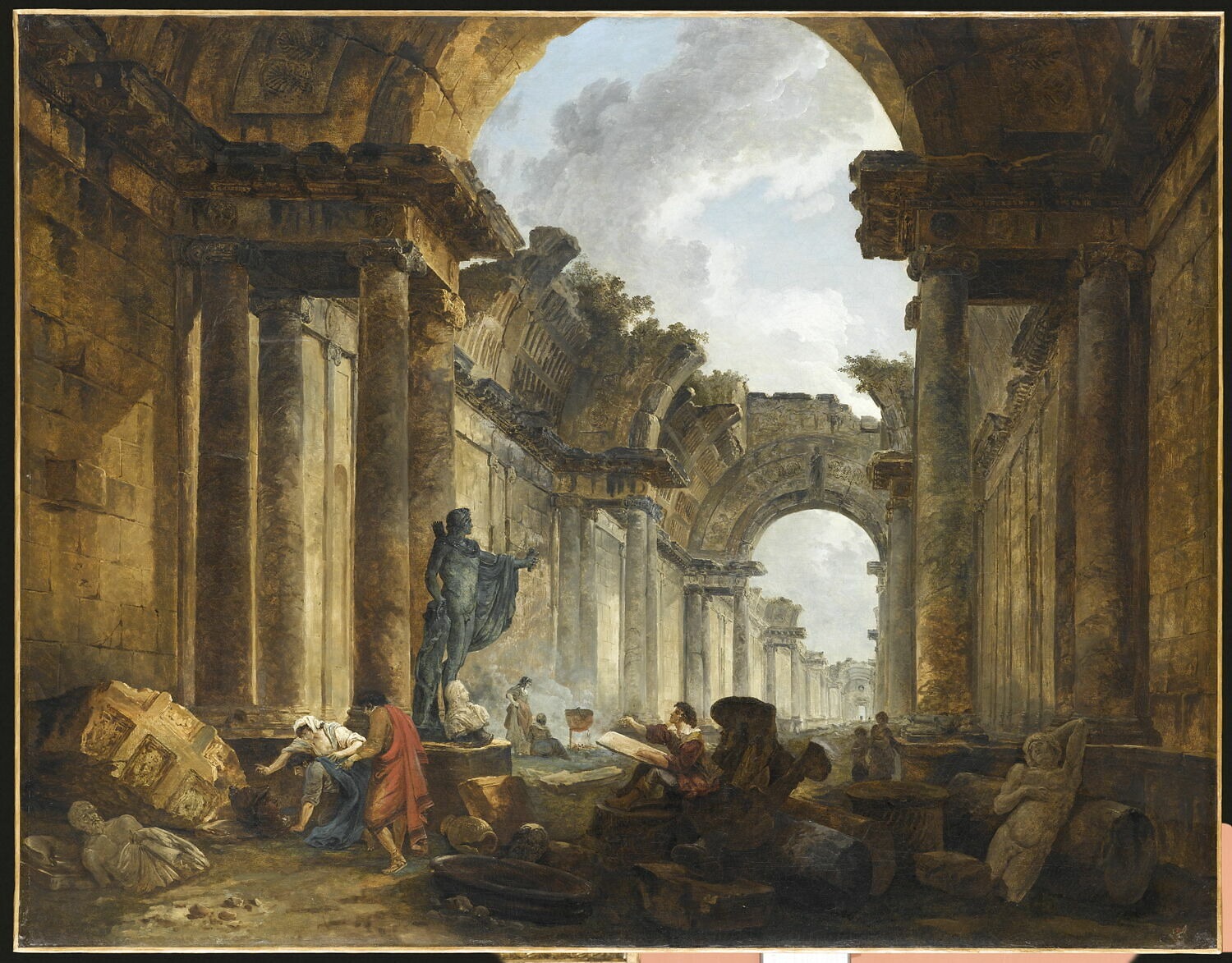
Robert’s association with the Louvre gives the image a particular force. He served as a curator and participated in the museum’s institutional life.11 The fantasy of its destruction came from someone involved in the work of arranging and preserving art.
The painting allows an unsettling exchange of positions. A museum gathers remnants of other times and places, then presents them within an order that can appear stable. Robert exposes that order to time in turn. The building that gives fragments a home becomes a source of fragments. Its own arrangement can become something a later visitor must interpret.
Beside Skyrim, the painting suggests a way to read the collector’s house from the future. Imagine entering it without knowing the player who assembled it. The carefully chosen objects remain, but the explanations have gone. A sequence of achievements might resemble a puzzling concentration of weapons. An intimate memory might look like an ordinary bowl in an unexpected place.
What seemed a complete account while its maker was present becomes partial evidence after their absence. The collection has preserved things without guaranteeing that anyone will understand the relationships between them.
This is a comparison across media, rather than a claim that Robert influenced Skyrim. The painting and the game make different kinds of experience available. Robert fixes the imagined aftermath in an image. Skyrim lets the player participate in the movements through which one arrangement supplies material for another. Looking from one to the other brings the apparent destination of that movement into question.
The museum at the end of the world is not securely outside the world’s ending. It is another arrangement within it. The desire to keep things safe and intelligible remains worthwhile, but it cannot make the arrangement timeless.
Leaving something for the world
There is a small experiment a player can try without changing the game. Choose an ordinary object in a place worth attending to. Before taking it, record what surrounds it and what, if anything, that arrangement suggests. Then consider three possibilities: leaving it, selling it, or keeping it somewhere of your own.
The exercise does not assign moral scores to those choices. It asks what each makes easier to remember. Leaving an object preserves its current arrangement within the terms of the game. Selling it converts its usefulness into another form. Keeping it allows a new association to grow. None automatically preserves the whole encounter.
A photograph or short note can hold something that possession alone does not: where the thing was, what was beside it, why the player paused. Such records would have limits of their own. A screenshot selects a view. A note selects an interpretation. But they make attention to context an activity that can accompany acquisition rather than disappear behind it.
This returns the question of belonging to the world outside the house. A familiar road can matter without becoming a trophy. A room can be worth revisiting even when it has nothing left to give. The possibility of remaining interested after usefulness has been exhausted is one measure of how much life a designed world can accommodate.
The bowl can stay on the shelf. Nothing in this argument requires emptying the house. But its meaning becomes richer when the shelf is understood as one episode in its story, and when the place it came from remains available to thought.
We can carry something home without assuming that we have carried the whole world with it.
All web sources consulted on 7 October 2026. This essay is a critical interpretation of documented game features and a visual comparison, not a participant study or a report of an original gameplay capture.
Footnotes and references
- Henry Jenkins, “Game Design as Narrative Architecture,” in Noah Wardrip-Fruin and Pat Harrigan, eds., First Person: New Media as Story, Performance, and Game (MIT Press, 2004), pp. 118–130. Author-hosted text, especially the discussion of environmental storytelling and embedded narratives. Read source ↩
- Prima Games, The Elder Scrolls V: Skyrim guide, “Hold Capital: Markarth,” sections “Lore: City Overview” and “Understone Keep.” Used for the city’s Dwemer construction, subsequent occupation and present uses, not as a neutral account of its fictional political conflicts. Read source ↩
- Prima Games, The Elder Scrolls V: Skyrim guide, “Inventory,” entry for “Dwemer Bowl.” Weight and value are the guide’s listed game attributes. The conceptual object itinerary in this essay is not a captured play session. Read source ↩
- Igor Kopytoff, “The Cultural Biography of Things: Commoditization as Process,” in Arjun Appadurai, ed., The Social Life of Things: Commodities in Cultural Perspective (Cambridge University Press, 1986), pp. 64–92. The publisher’s chapter summary supports the account of changing commodity status used here; applying it to Skyrim is this essay’s interpretation. Read source ↩
- Prima Games, The Elder Scrolls V: Skyrim guide, “Side Quests,” subsection “The Golden Claw,” including the puzzle solution and return to Lucan. Read source ↩
- Bethesda, The Elder Scrolls V: Skyrim Anniversary Edition, “Hearthfire.” Official description of land purchase, home construction and furnishing. Read source ↩
- Russell W. Belk, “Possessions and the Extended Self,” Journal of Consumer Research 15, no. 2 (1988): 139–168. The publisher’s abstract supports the broad relationship between possessions and identity; this essay does not report empirical findings about Skyrim players. Read source ↩
- icecreamassassin and the Legacy team, “Legacy of the Dragonborn SSE,” creators’ description and feature list. Features described here concern the mod; no total display count or claim about typical player behaviour is inferred. Read source ↩
- Prima Games, “Hold Capital: Markarth,” subsection “Dwemer Museum.” This source also describes the concentration of locked containers. Read source ↩
- Hubert Robert, View of the Grande Galerie of the Louvre in Ruins, 1796, Musée du Louvre. Title, date and collection checked against the National Gallery of Art’s 2016 exhibition checklist. The visual reading concerns the reproduced painting. Read source ↩
- National Gallery of Art, “Hubert Robert,” biography adapted from Philip Conisbee et al., French Paintings of the Fifteenth through the Eighteenth Century (2009), p. 403. Read source ↩