The first visit to a fictional place can belong partly to somebody else's memory. A player arrives carrying images from books, films and earlier encounters with Middle-earth. Recognition precedes experience. The name of a village may already matter before the player has done anything there.
Repeated play introduces another kind of familiarity. A place can become legible through its turns, distances and ordinary approaches. What initially commands attention as a reference to Tolkien's world can acquire a more local significance: somewhere passed through, returned to, or understood without needing to consult a map.
Taking the author's repeated play of The Lord of the Rings Online as its starting point, this study examines that transition. Its central question is how a fictional landscape becomes a place to which a player can develop a personal relationship. The Shire provides the focus for a critical reading of movement, recurrence and attention.
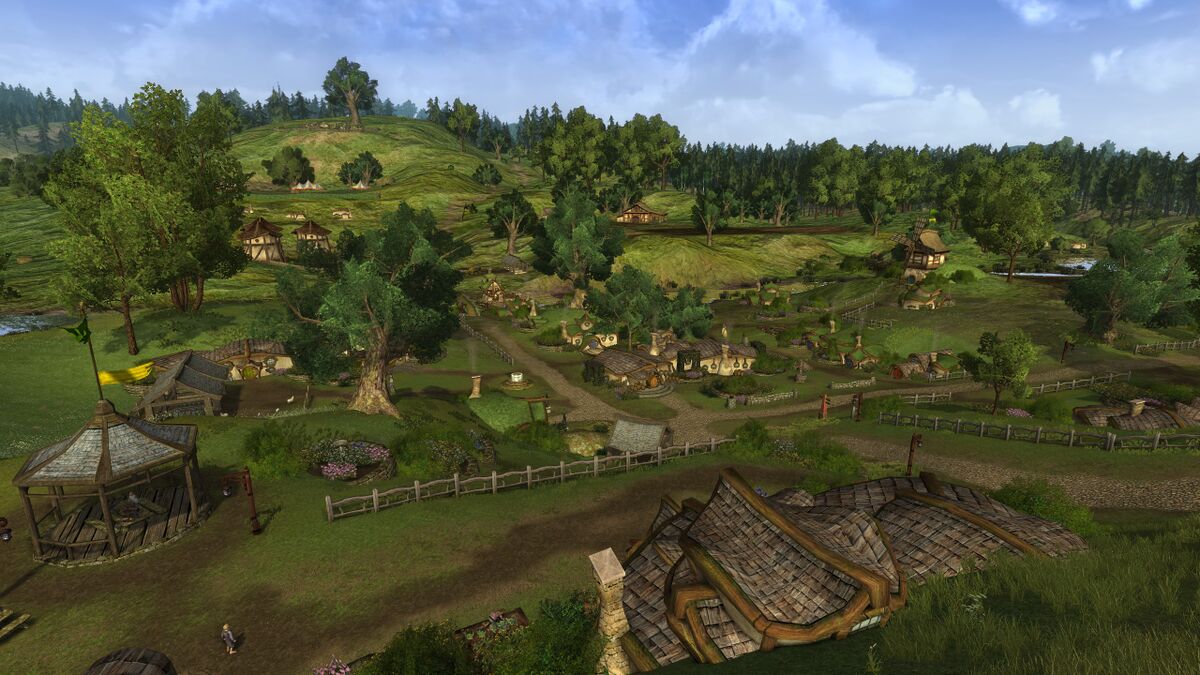
A world between destinations
LOTRO's official presentation places exploration and everyday activities, including farming in the Shire, alongside heroic advancement.1 That combination makes it possible to ask what a game world offers in the intervals between its more explicit objectives.
A destination gives a journey a purpose. It also organises what deserves attention along the way. When the player is occupied with arriving, a bend in the road may register chiefly as a navigational instruction. When the immediate objective loosens, that same bend can become available for another kind of attention: its view, its relationship to nearby buildings, or the feeling of approaching somewhere already known.
The distinction is a shift in the use of the landscape. The road still connects the same places. Its significance changes with the player's activity.
For RuneWeb, this places inhabitation within the ordinary operation of a game. A world can support attachment through small acts of return as well as through exceptional encounters. The interpretive proposition of this study is that repeated movement can make a landscape personally meaningful, especially when there is room to attend to more than the next destination.
Recognition and belonging
Several different experiences can be compressed into the phrase “this feels familiar.” A player might recognise a name from Tolkien, remember a location from earlier play, know how to navigate it, or feel emotionally connected to it. These experiences can reinforce one another, but they are not interchangeable.
Scannell and Gifford's framework for place attachment distinguishes the person, the psychological processes involved, and the place itself. Within those processes, emotion, cognition and behaviour are related but distinct.2 Applied here, the framework prevents an easy mistake: treating improved navigation as sufficient evidence of belonging.
The player who knows a shortcut has learned something about a place. Whether that knowledge becomes affection depends on what the place means within their play. A convenient route might remain wholly practical. An inconvenient one might become important because it holds an association, enables a preferred activity, or invites a particular mood.
Williams and Vaske's research distinguishes place dependence, concerning how a place supports activities, from place identity, concerning its personal and symbolic significance.3 These concepts were studied in physical recreation settings. Used cautiously as interpretive tools, they help articulate why a useful destination and a meaningful destination need not be the same thing.
The Shire's literary identity adds another layer. A player can feel attached to the idea of the Shire before becoming attached to any particular rendering of it. The question is how repeated play might add personal associations to that inherited significance.
Three ways of reading the same journey
The analytical experiment is to consider a familiar journey under three different descriptions. These are lenses for interpreting play, rather than reconstructed records of three measured sessions.
| Reading | What organises attention | What the landscape can become |
|---|---|---|
| Passage | Reaching the next destination | A sequence of directions and distances |
| Return | Anticipating what is already known | A network of recognisable relationships |
| Dwelling | Choosing where to pause or remain | A setting for an activity or association of one's own |
Passage makes the route legible through completion. A landmark matters because it confirms progress or signals a turn. This is a coherent and often pleasurable way to play; purpose can sharpen attention as well as narrow it.
Return adds anticipation. A known place can enter awareness before it appears on screen. The landscape is understood partly through what is expected to follow. In this reading, familiarity becomes a relationship between locations, rather than a collection of remembered images.
Dwelling introduces discretion. The player can decide that a location deserves a pause even when progress does not require one. A place begins to support a use that the player has chosen: looking, waiting, taking a picture, or simply remaining for a while.
These modes need not form a sequence. A player may move between them during one journey. Nor is dwelling inherently a deeper or better form of play. The important question is whether the world accommodates changes in attention and purpose.
A pause in the Shire
One view, three kinds of attention
Change the lens to explore a possible reading of the same scene.
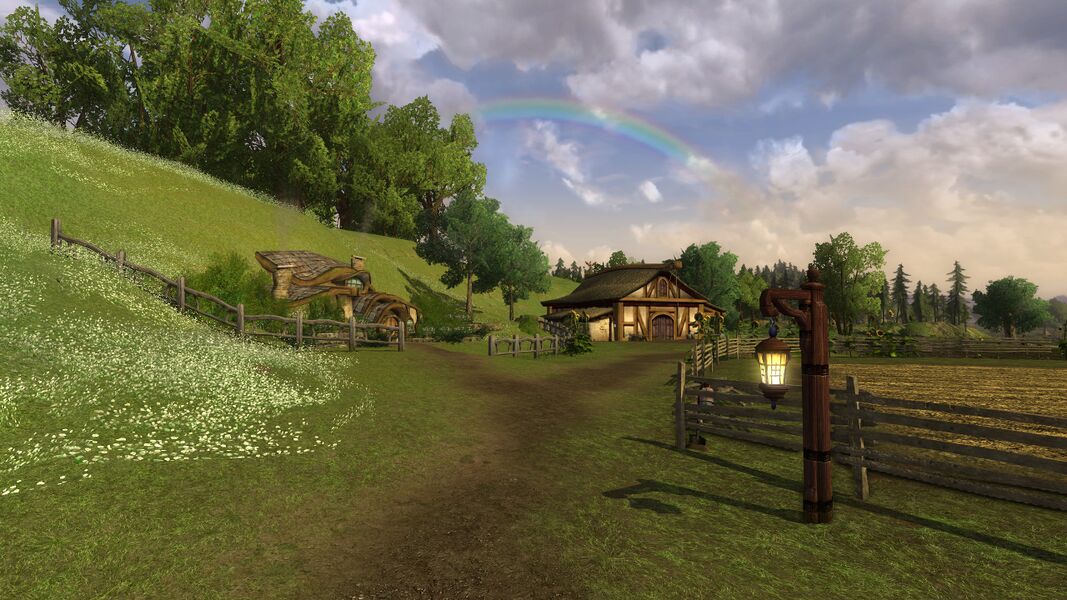
Where does this lead?
The path as a direction
Read the road as a way through: its bend and the buildings ahead organise the journey around reaching a destination.
Repetition has two possible directions
It would be convenient to conclude that familiarity naturally becomes affection. The research supports a more conditional account. Montoya and colleagues' meta-analysis of mere exposure found an overall pattern consistent with an inverted U: repeated exposure can increase liking, while further repetition may cease to help or begin to diminish it.4 Those findings do not establish the effects of repeated travel in LOTRO. They make boredom an essential alternative to consider.
The same recurring journey can be understood as a welcome ritual or an obligation. The distinction may involve freedom, purpose, timing and the availability of alternatives. Returning because one wants to be somewhere gives repetition a different context from returning because an unfinished task requires it.
This leads to a more precise proposition: repetition may contribute to attachment when it allows a place to accumulate personal significance; familiarity alone is insufficient.
That proposition also makes room for ambivalence. A player may know a location intimately and still want to leave. Banks and Bowman's research on sense of place includes both positive and negative relationships with physical and digital spaces.5 A strong sense of place should therefore not be reduced to comfort. Irritation, melancholy or estrangement can also make somewhere distinctive.
The Shire is productive for this inquiry because recognition, everyday activity and the larger promise of travel can be considered together. Its significance need not depend on perpetual peacefulness. A place can matter as somewhere to leave, somewhere to cross, or somewhere to return to.
Reading the argument
Familiarity can take different paths
Repeated encounters with a place
Room to choose, pause and return
A possible ritual
Personal associations may accumulate.
Pressure to repeat the journey
A possible obligation
Familiarity may coexist with boredom.
What the study brings into focus
The analysis offers three working conclusions.
First, a fictional setting can carry several kinds of familiarity at once. Literary recognition, navigational knowledge and personal attachment should be examined separately, even when they coexist.
Second, return makes time part of a landscape's interpretation. The significance of a location can include previous encounters and anticipated ones. A screenshot records an appearance; a relationship with a place includes what the image cannot show.
Third, repetition becomes more interesting when considered alongside agency. The opportunity to return, linger or leave may matter as much as the frequency of exposure. A design that invites recurrence raises different questions from one that requires repeated traversal.
These are interpretive conclusions, not measured effects. They provide a framework for reading experience and for designing more focused observations.
A small exercise for the Lab
Choose a route in LOTRO that you already know. Before travelling, write down what you expect to see. Move through it once with an ordinary destination in mind. On another visit, give yourself permission to pause wherever you choose.
Afterwards, record three things: a feature you anticipated, something you noticed only when your pace or attention changed, and a place you would voluntarily revisit. “Nothing” is a useful answer to any of these prompts.
Keep memory and observation distinct. If a detail comes from recollection, label it as remembered; if it was recorded during the visit, attach the date and image. Consider whether the desire to return concerns the location itself, an activity available there, or an association carried into the game.
This exercise turns the article's interpretation into something a reader can examine through their own play. It can support a field note, an annotated image sequence, or a comparison between remembered and observed details, without requiring a numerical score for belonging.
Designing for return
For RuneWeb, the design implication is to give existing places opportunities to acquire significance. A small world might sustain interest through recognisable approaches, recurring activities and room for self-directed pauses. Its depth could grow through the player's relationship with what is already there.
This remains a design proposition to explore. The experience of an established MMO includes other players, sound, character history, literary associations and changing circumstances. A route cannot explain all of it.
What the Shire offers this inquiry is a way of thinking about the ordinary spaces through which a world becomes known. The question concerns what happens across encounters: when does a road through somebody else's imagined world begin to hold a memory of your own?
Method note
This experience-led critical study takes Eric-Ross McLaren's repeated play of LOTRO as its context and develops an interpretation alongside published research. Its arguments concern possible relationships between familiarity, attention and attachment; they do not constitute a record of specific route trials or measured outcomes. The reader exercise offers a way to extend the inquiry through documented observation.
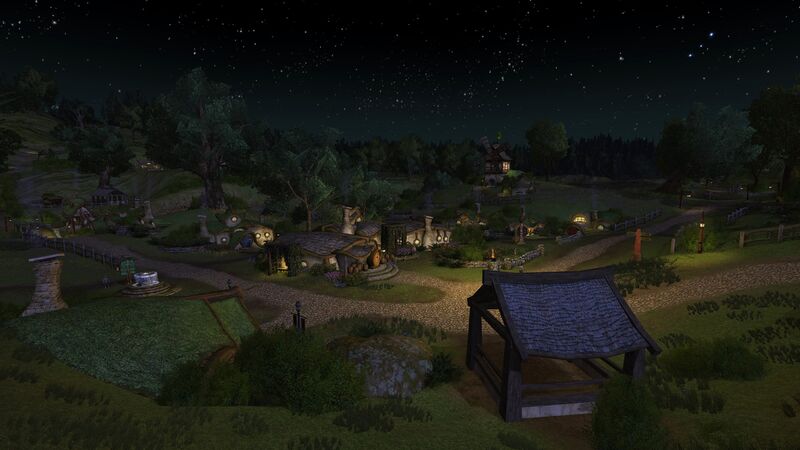
The game screenshots are sourced illustrations, separate from the author's play sessions. The daytime and night-time views are independent captures, rather than a controlled comparison.
Footnotes and references
- Standing Stone Games, “About The Lord of the Rings Online”. Official description of exploration, progression and crafting, including farming in the Shire. Accessed 25 September 2026; this is evidence of the game's presentation, not of players' emotional responses. ↩
- Leila Scannell and Robert Gifford, “Defining place attachment: A tripartite organizing framework”, Journal of Environmental Psychology 30, no. 1 (2010): 1–10. Accessible article PDF. ↩
- Daniel R. Williams and Jerry J. Vaske, “The Measurement of Place Attachment: Validity and Generalizability of a Psychometric Approach”, Forest Science 49, no. 6 (2003): 830–840. US Forest Service record and full-text link. The original research concerns physical recreation settings; its distinctions are used here as interpretive tools. ↩
- R. Matthew Montoya, Robert S. Horton, Jack L. Vevea, Martyna Citkowicz and Elissa A. Lauber, “A re-examination of the mere exposure effect: The influence of repeated exposure on recognition, familiarity, and liking”, Psychological Bulletin 143, no. 5 (2017): 459–498. Indexed abstract. The summary uses the abstract; this was not a LOTRO study. ↩
- Jaime Banks and Nicholas David Bowman, “Symbolism, purpose, identity, relation, emotion: Unpacking the SPIREs of sense of place across digital and physical spaces”, Poetics 105 (2024): 101916. The discussion here draws on the publisher's accessible abstract and article preview. ↩