A chair is in the wrong place. It is a perfectly good chair: the right colour, an agreeable shape, a small improvement on the one that came before. But someone needs to pass it to reach the table. Moving it towards the window makes the room look less resolved. Leaving it where it is makes the room less generous.
For a moment, decoration becomes a question about another person's day.
This is one of the most interesting things a game about furnishing houses can make available. A player begins by choosing objects and discovers that they are also distributing possibilities. Somewhere to sit becomes somewhere to wait. A door establishes who can withdraw. A desk gives an activity a permanent claim on the room. The arrangement starts to suggest which kinds of life will be easy there, and which will require accommodation.
This essay reads domestic building in The Sims, with The Sims 4 as its principal design reference, as a practice of allocating room for everyday life. Its argument is that a furnished home can be understood as a provisional agreement between competing activities: sleeping, working, receiving others, displaying things, being alone. Taste enters that agreement, but so do space, money, the available catalogue and the builder's idea of an inhabitant.
The three houses below are original editorial propositions, accompanied by an interactive model. They have not been built or playtested in The Sims. Keeping that distinction visible allows the exercise to ask a precise question without borrowing the authority of observations it has not made: when the available space stays the same, what changes when the priorities change?
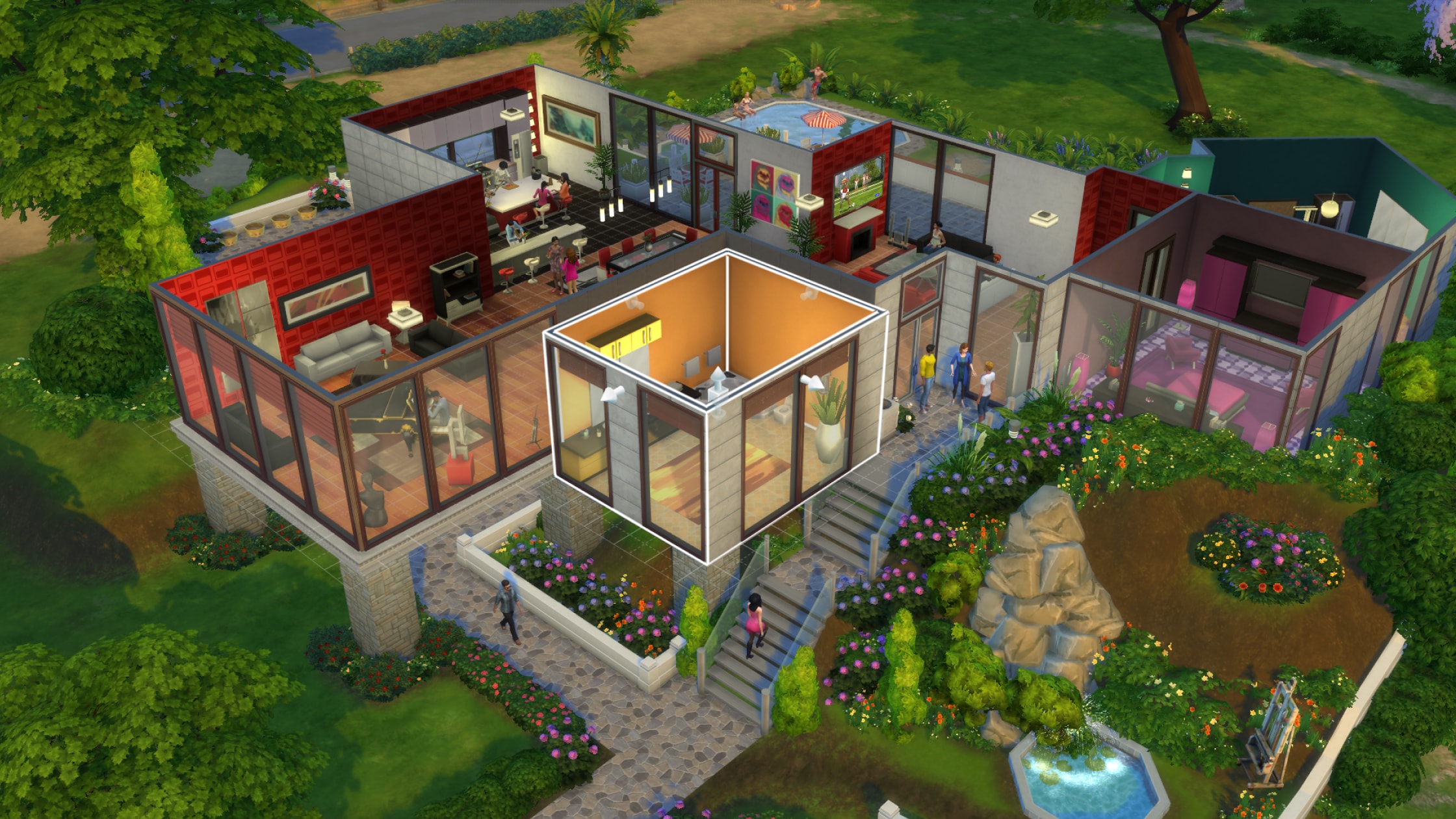
Before anybody moves in
EA's description of The Sims 4 presents Build Mode as a way to construct and customise homes. Its building tools make rooms and furnishings available for repeated alteration. That capacity to revise matters: domestic arrangements become things a player can propose, reconsider and try again.1
There is a peculiar interval in this process. The house has acquired a bed, a bathroom and a place to prepare food, but nobody has yet interrupted its composure. A visitor has not needed somewhere to put a coat. A second activity has not competed for the table. The builder can still regard every object from the position that flatters it.
The beautiful room and the accommodating room may coincide. They need not. A composition judged from above can give little attention to the experience of approaching something, passing another person or wanting to be out of sight. The freedom to see the whole house can obscure the limited viewpoint of the person imagined inside it.
The useful critical move is to alternate between these positions. First consider the house as an image. Then ask it to host an ordinary event. Someone arrives early. Someone is tired. Someone would like to work while somebody else talks. The event does not automatically disprove the design. It reveals the terms on which the design welcomes it.
Taste arrives with a catalogue
An apparently personal choice begins within a selection somebody else has organised. The catalogue determines which objects are available, how they are grouped and which forms of domestic life can be assembled conveniently. A player can be inventive within those conditions, while the conditions still matter.

Mary Flanagan's 2003 reading of the original The Sims places its domestic space within histories of gender, suburbia and consumption. Her analysis makes the home a cultural proposition embedded in a game, rather than a neutral container for play. It concerns an earlier title; it does not establish how every later instalment works or how every contemporary player understands it.2
Charles Paulk's 2006 study likewise treats furnishing in the original game as a field of social meaning. He connects the arrangement of interiors with consumer culture and the signs through which an inhabitant presents a way of life. That account provides a vocabulary for questioning taste, rather than a reliable method of diagnosing a person from their sofa.3
A sparse room might express restraint, an unfinished project, a limited catalogue or a joke. A lavish room might be a fantasy the builder has no desire to inhabit. The same visible arrangement can emerge from different intentions. Reading a home critically requires attention to the decisions that produced it, including decisions made for someone else's imagined character.
Class belongs in that inquiry as a question about available resources and recognisable signs of aspiration. It becomes reductive when every pale wall is treated as evidence of privilege or every crowded shelf as evidence of authenticity. An object can communicate status; its appearance cannot supply a complete biography of its owner.
Three houses, one envelope
Consider a small hypothetical dwelling represented by ninety-six units of floor area. In each version, twelve units are reserved for cooking, eight for washing and eight for circulation. The remaining sixty-eight are divided between sleeping, shared space and working.
These units are a comparison device, not square metres or measured Sims tiles. The coloured diagram records area allocation. It leaves out wall thickness, doors, dimensions, furniture clearance and actual game routing. The resulting shapes are programme diagrams, not habitable architectural plans.
Each house also receives the same fictional budget: 120 tokens, including sixty reserved for a basic shell and essential provision. The other sixty express furnishing priorities. No token corresponds to a current Simoleon price. The point of holding the allowances constant is to make the cost of a preference visible.
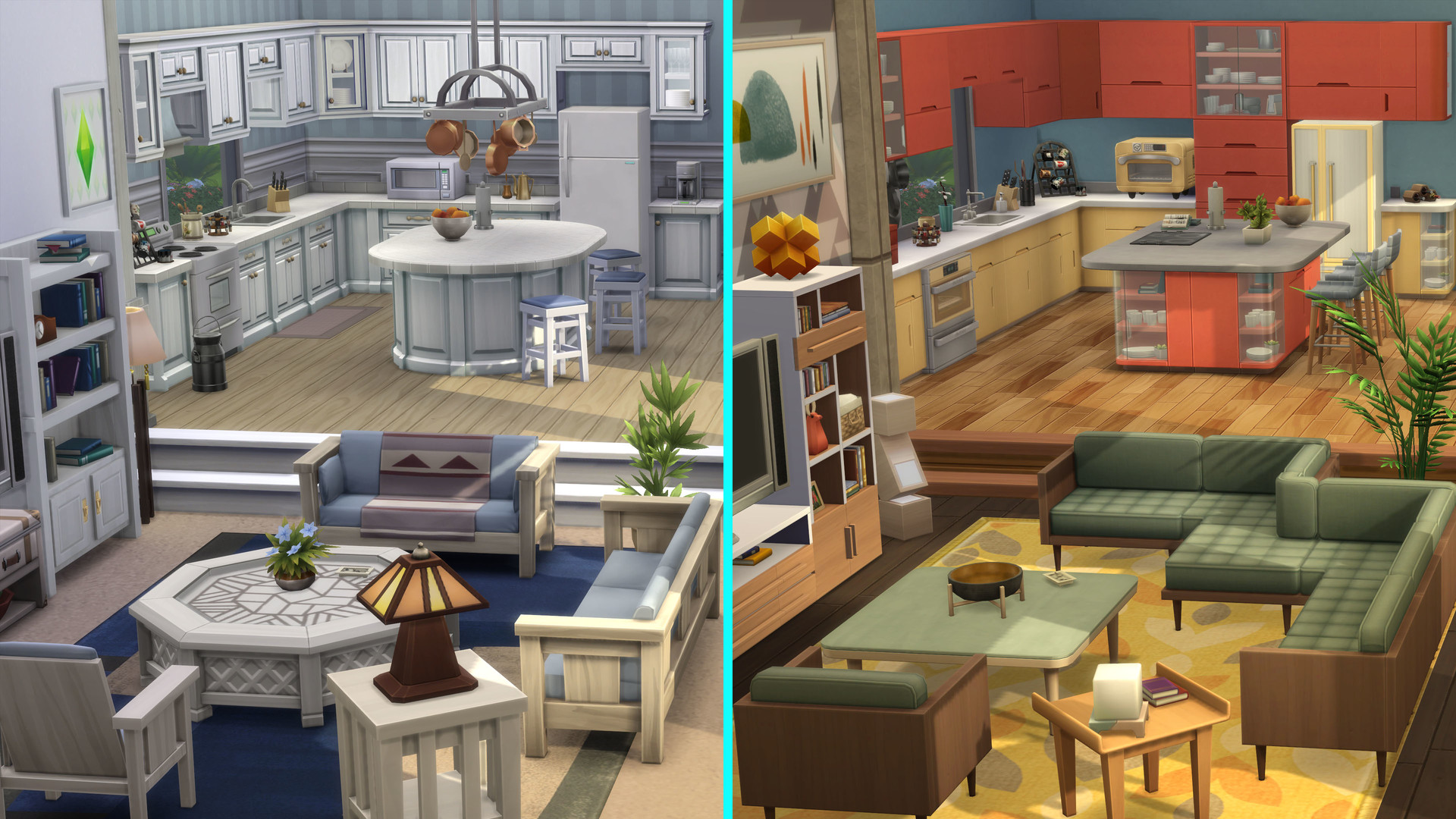
What deserves room?
Three briefs. The same 96 units. Choose a house, then inspect an allocation.
Area diagram · 12 × 8 units
Schematic allocation; no doors, walls or game routing.
Room for one more
Shared space receives 40 of 96 area units. Working receives 8. The brief gives company the largest claim; it leaves a project with less dedicated room.
Where does the unfinished work go when the table is needed?
Shared space: A generous common area makes a claim for being together. It cannot tell us how welcome anyone will feel.
What this diagram can show
The coloured squares show exact invented area allocations. Each house totals 96. Cooking (12), washing (8) and circulation (8) stay fixed. The grid groups the allocation into a readable picture; it is not a tested floor plan and does not predict feelings, accessibility or function.
| Allocation | The Open Table | A Room of One's Own | The Carefully Seen Home |
|---|---|---|---|
| Cooking | 12 | 12 | 12 |
| Washing | 8 | 8 | 8 |
| Circulation | 8 | 8 | 8 |
| Sleeping | 20 | 20 | 28 |
| Shared space | 40 | 16 | 32 |
| Working | 8 | 32 | 8 |
| Total floor-area units | 96 | 96 | 96 |
The Open Table gives the largest share to being together. Its proposition is that a home should absorb another person without treating their arrival as a disruption. A meal, a conversation and an unfinished activity might share its centre. The sacrifice appears elsewhere: a modest work area has to negotiate with the social life around it.
A Room of One's Own gives sustained attention a substantial claim. The working area becomes a place an activity can occupy between sessions, rather than something that must be packed away before dinner. Its smaller shared space asks for more planning when company arrives. Privacy is treated as a positive provision with a spatial cost.
The Carefully Seen Home gives more room to sleeping and a composed shared interior, with little dedicated work space. It imagines a dwelling arranged partly around how it appears and the atmosphere its inhabitant wants to return to. That desire deserves examination without automatic ridicule. An ordered view can itself be a pleasure. Its limitation becomes apparent when an activity needs to remain unfinished in the middle of the picture.
None of the three is the correct house. Nor do the diagrams prove that an area allocation will produce a particular feeling. They make three briefs legible, so that the reader can challenge the fit between a brief and the life it anticipates.
A budget remembers what you preferred
The fictional furnishing budget makes another part of the agreement explicit. Sixty discretionary tokens can be divided between shared life, personal retreat and making or working. Increasing one allocation leaves less available for the others. Spending more than the allowance creates a deficit; the model lets that deficit remain visible.
Spend a little attention.
60 tokens cover the shell and essentials. Allocate the other 60. You can exceed the allowance and inspect the shortfall.
HOUSEHOLD POSSIBILITIES
- Shell + essentials
- 60
- Shared life
- 35
- Personal retreat
- 15
- Making / working
- 10
- Total
- 120
Keep the question.
You may rearrange the answer.
What the budget means
The total is 60 fixed tokens plus your three allocations. Remaining allowance is 120 minus that total. A negative remainder means the choices exceed the allowance. Tokens describe editorial priorities, not actual item costs, usable floor space or human outcomes. The presets all total 120.
The interesting output is a receipt, rather than a score. It records what has received provision and what has been postponed. There is no conversion from tokens into happiness. A house cannot be declared caring because it spends thirty tokens on hospitality, and solitude cannot be read from a slider. Those would be claims about experience for which the model has no evidence.
The receipt instead supplies a small discipline of explanation. If working receives the largest share, what is the inhabitant making? If shared life receives little, is the house intended as a retreat, or has the builder forgotten that other people might visit? A choice becomes easier to discuss when its opportunity cost has a name.
The Sims 4 also permits players to alter some constraints. EA documents money cheats and the move-objects cheat, which changes placement freedom.4 Removing a budget can open a different creative activity. It can also show that money was only one limit: attention, the available catalogue, technical behaviour and the builder's own brief remain.
This is why a constraint needs to be chosen in relation to a question. An unlimited build can be an excellent study of an atmosphere. A fixed allowance is more useful for examining sacrifice. Neither mode has a monopoly on serious play.
A door is a decision about company
The floor-area diagram leaves out a crucial distinction: the same amount of space can be connected in different ways. A study reached through a bedroom makes a different arrangement of privacy from one reached through a shared hall. A room with a door can offer withdrawal; a room without one may require withdrawal to become a conversation.
Architecture distributes the need to ask. Some arrangements let an inhabitant act quietly and independently. Others make an ordinary activity contingent on negotiating with someone else. The question extends beyond whether a room can technically contain a desk. It concerns what else must stop for the desk to be used.
Imagine a guest arriving while the inhabitant is working. The Open Table has made a generous place for the encounter, but the work may lose its setting. A Room of One's Own protects a project, but may ask the visitor to accept a smaller common area. The Carefully Seen Home may accommodate the guest beautifully while struggling with the bag, charger and coat that arrive with them.
These are possible readings of the briefs, not simulated outcomes. Changing the imagined inhabitant can change the assessment. A sociable writer, a private cook and someone working night shifts might each find a different inconvenience decisive. A design becomes more interesting when its intended life can answer back.
The cup that makes the room look lived in
EA markets the Everyday Clutter Kit through small objects associated with hobbies and daily routines, including cups, magazines and personal supplies. The product makes the signs of everyday occupation available as deliberate decorative choices.5
A cup can therefore perform two quite different roles in a reading of a room. It may be the trace of an activity, or a sign placed to suggest that the activity has happened. The finished image can make the two difficult to distinguish. Domestic irregularity becomes something the builder can compose.
There is pleasure in that small fiction. A pile of books can imply a person who keeps meaning to return to something. An extra chair can suggest hospitality before anyone arrives. But the distinction between representing a life and making room for it remains useful. A room may look wonderfully inhabited while giving its imagined inhabitant very little space to act.
A room can keep a small secret.
Keep a place
It matches nothing. Someone can sit there.
A generous reading
The chair waits beside the table because the inhabitant likes a visit that does not need to be arranged.
Three invented interpretations. An object's appearance does not tell us its owner's biography.
The object cabinet offers three short readings. They are invitations to interpretation, not descriptions of particular game assets. Each object can change meaning when its supposed history changes. The unused chair might be waiting for a friend. It might also be the chair nobody likes.
Whimsy grows here from the possibility of being slightly wrong about the room. A solemn composition can contain an object with a much less solemn explanation. The home acquires character when its parts do not all seem to have agreed to the same photograph.
A small domestic interruption · press play
Permission to play with domestic life
A game about houses need not merely repeat domestic obligation. In a qualitative interview study, Miriam Vosmeer, Jeroen Jansz and Liesbet van Zoonen found that participating adult women valued The Sims for control, fantasy and challenge. Their accounts also described play as time deliberately separated from household and family duties. These findings concern the study's participants, not all women or all players.6
The distinction is important for interpreting a builder's choices. Someone who spends leisure time arranging a kitchen may be enjoying the freedom to decide, the visual problem or the possibility of making something absurd. The activity's resemblance to household work does not establish that it carries the same social meaning.
Equally, the miniature house can make authorship available at an approachable scale. A window can move. A room can change purpose. An unsuccessful arrangement can be revised. Decisions that may be expensive, forbidden or dependent on others in a physical dwelling become available for experimentation within the game.
That freedom is uneven and bounded. It depends on access to the game, its tools and the content a player can use. Yet the possibility of revision is still significant. The builder can temporarily inhabit the position of someone whose preferences are allowed to alter the room.
When the real home cannot be kept
Miriam Osburn's essay Simulated Interiors: Unreal Estates and The Sims places a virtual reconstruction of a former home alongside her account of eviction in Sydney. It examines how digital interiors and insecure physical housing can affect one another, proposing that a simulation may become a kind of substitute interior. This is a situated critical account, not evidence that virtual homes remedy housing insecurity.7
It changes the question an empty virtual room can carry. The builder may be imagining a future, rehearsing a different present or holding on to something already lost. A familiar arrangement can matter even when its objects are ordinary and its proportions imperfect.
The capacity to reconstruct is different from the capacity to recover. A remembered kitchen in a game does not restore a tenancy, a neighbourhood or the people who once passed through it. It can give certain relationships between things somewhere to remain visible. The door can still be near the table. The window can still face the direction remembered.
A critical account of digital domesticity should leave room for that modest significance. An image of a home can participate in memory without being mistaken for a solution to the conditions that made the memory painful.
Let something inconvenient arrive
A house built to satisfy its own brief can become too easy to praise. One way to question it is to introduce a condition the builder did not select.
Research on random build challenges in The Sims 4 examines examples in which players, game materials and randomisers jointly shape a build. Its discussion of three YouTube challenges draws attention to invention under conditions the player does not fully control. It also recognises that completing a challenge does not necessarily produce a functioning home.8
The invitation below borrows that procedural idea for a different purpose. Draw a domestic interruption, then reread one of the three house propositions. The interruption does not change the model's numbers or simulate an inhabitant. It changes the question being asked of the arrangement.
The brief did not mention this.
Draw an interruption. Take it back to one of the houses.
To the person arranging the room
Something ordinary is about to happen.
Leave a little space for it.
Fictional prompts for interpretation. They do not simulate a household or alter the budget.
An overnight guest might reveal that the supposedly spare area already belongs to something. Working late might make the position of a light more important than its appearance. An inherited chair might disturb a carefully chosen palette while carrying a reason to stay that the palette cannot express.
An inconvenient object can be a particularly good critic because it asks for a decision without accepting the designer's original criteria. The chair is not beautiful enough. It belonged to somebody. Both statements can be true, and neither quite settles where it should go.
A small method for looking again
The exercise can be taken into The Sims 4 as a future study. Choose one version of the game and record the packs, custom content and cheats in use. Start from the same shell, household and remaining funds for each build. Change the brief while keeping those starting conditions fixed. Keep screenshots, item costs and notes for each version.
Then test the buildings in Live Mode. Record what actually happens when Sims approach furnishings and carry out the same selected actions. A camera-ready interior and a usable one may differ; only observation can establish where they differ in these particular builds. Do not treat a game-routing problem as evidence about real human wellbeing.
Finally, return to the builder's intention. Identify one choice made for appearance, one for a practical activity and one for a story. Ask which survives an interruption. If other people contribute builds or interpretations, obtain their consent before quoting them or publishing identifying material, and let them explain what their arrangements mean.
This method would produce a comparative record. The present essay supplies the questions and the illustrative model; it does not claim to have completed that study.
Somewhere the chair can stay
The chair by the window is still slightly wrong. Moving it improved the route to the table, but weakened the composition. Perhaps the house can tolerate that. Perhaps an image of effortless order was asking too much of a place meant to accommodate things happening.
The value of reading The Sims through its interiors lies partly in making these small negotiations available for attention. A house carries ideas about adulthood, company, work, display and retreat. Those ideas become easier to recognise when a player has to decide where something belongs.
For RuneWeb, this makes domestic building a useful meeting point between visual culture and inhabited worlds. The arrangement can be studied as an image and questioned as an invitation. Its most revealing detail may be a preference that had seemed too ordinary to explain.
A house is made of decisions. A home also needs somewhere for the decisions to be revised.
Method and image note
This is a research-led critical essay with an original illustrative model. It draws on official product documentation and published scholarship; passages about possible experiences are interpretations or design propositions. Earlier scholarship on the original The Sims is identified as historical context. No player interviews, in-game builds or gameplay observations were conducted for this article.
The house programmes, token costs, object stories and interruption cards are invented for RuneWeb. They are not measured game data, architectural advice, personality tests or predictions of wellbeing. All three area allocations sum to 96. Each preset furnishing budget sums to 120 tokens, including 60 fixed tokens. Reader edits may deliberately exceed the allowance, in which case the deficit is displayed. The downloadable receipt records these assumptions.
The game imagery comes from Electronic Arts' official The Sims 4 pages, the publisher's Dream Home Decorator listing on Steam, and The Sims' official GIPHY channel. Captions link to each source. These are publisher-supplied images and gameplay media, not records of builds undertaken for this essay. The GIF uses GIPHY's accompanying video version in the reading edition so it can be played and paused; it starts still. The separate coloured diagrams explain the fictional model. Controls support keyboard use, the brief decorative movements respect reduced-motion preferences, and the article remains readable without interaction. Sources and image credits were checked on 25 September 2026.
Notes and references
Footnotes and references
- Electronic Arts, The Sims 4: Tips and Tricks, official overview of Create a Sim, Build Mode and the Gallery. Used for the product's building invitation, not as evidence of player outcomes. ↩
- Mary Flanagan, “SIMple & Personal: Domestic Space & The Sims”, MelbourneDAC, 2003. Historical analysis of the original game through domestic space, gender and consumption. ↩
- Charles Paulk, “Signifying Play: The Sims and the Sociology of Interior Design”, Game Studies 6, no. 1, 2006. Its claims about particular mechanics and its period-specific social generalisations are not carried over to The Sims 4. ↩
- Electronic Arts, The Sims 4 Cheats: Frequently Asked Questions, official documentation of household-money and object-placement cheats. Placement freedom does not establish that every resulting arrangement will function in Live Mode. ↩
- Electronic Arts, The Sims 4 Everyday Clutter Kit, official product description. The interpretation of staged everyday traces is the article's own. ↩
- Miriam Vosmeer, Jeroen Jansz and Liesbet van Zoonen, “I'd Like to Have a House Like That: Female Players of The Sims”, Academic Quarter 11, 2015, pp. 129–141. Qualitative interview study; its findings are not a population-wide account of players. ↩
- Miriam Osburn, “Simulated Interiors: Unreal Estates and The Sims”, Idea Journal 21, no. 1, 2024, pp. 77–88. Used for its situated argument connecting a reconstructed virtual interior with the loss of a physical home. ↩
- “Random Build Challenges and Vital Materialism in The Sims 4: Influences, Innovations, and Improvisations”, Computers and Composition 65, 2022, article 102723. The publisher's abstract and accessible article preview describe three challenge examples; the RuneWeb interruption cards are an original adaptation of a procedural idea, not a replication of the study. ↩