AI-assisted worldbuilding, shared memory and the human work of making a digital commons
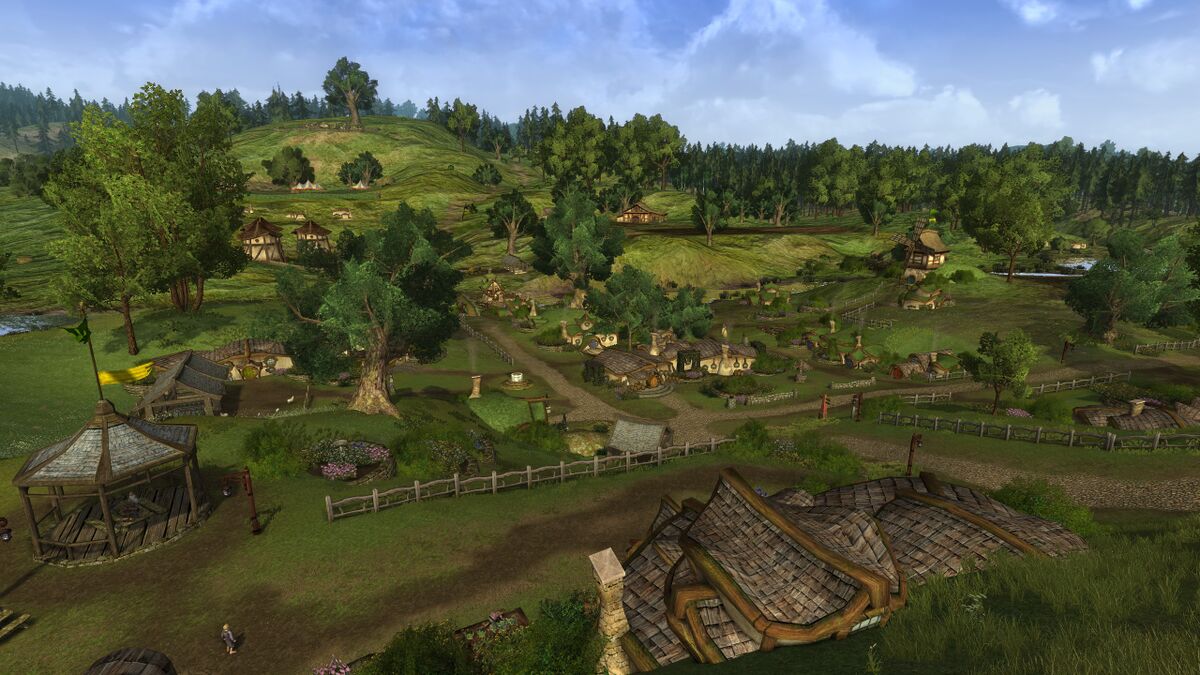
Imagine returning to an online courtyard a week after your first visit. The tree is still there. So is the bench someone moved towards its shade. A small listening pavilion has appeared at the edge of the garden, built from a sketch you left behind. Its roof follows another visitor’s suggestion; the recording playing inside belongs to someone who has never learned to model a three-dimensional object. Beside the entrance, a short history explains how the place came to be.
The scene is fictional. It introduces a design case called The Common: a proposal for a modest, persistent online world that people could build and inhabit together, with AI assisting its development. No prototype or participant study is being reported here. The question is whether existing technologies can support such a place, and what human arrangements would make it worth returning to.
The courtyard’s significance lies partly in recognition. Something has survived your absence. Something else has changed, and you can understand whose attention produced the change. The environment has acquired a history in which you have a small part.
Generative systems make this prospect newly tangible. They also make it easy to mistake the production of scenery for the creation of a world. A navigable scene, a multiplayer system and a community are different achievements. Each requires its own account of continuity, participation and responsibility. Bringing them together is a more demanding and more interesting project than increasing the amount of terrain an algorithm can produce.
The argument of this essay is that AI-assisted worlds become culturally promising when generation is placed inside a durable human process. As producing possible additions becomes easier, the scarce work shifts towards deciding what deserves to remain and caring for what has been accepted. People need ways to propose, revise, accept, inhabit and sometimes refuse changes. The world must remember those decisions without dictating what they mean. Its openness must extend to someone who arrives with a story or a sound, as well as someone who can write code.
A place before a picture
Online places did not have to wait for photorealism. In a 1992 Stanford seminar, Pavel Curtis described LambdaMOO as a networked, multi-participant environment that users could extend, conducted entirely through text. People could gather, communicate and contribute to a shared setting without an image of that setting being rendered for them. The historical point is modest but important: visual realism is one means of representing a place; it is not a prerequisite for social presence.1
This does not make visual and sensory design incidental. A particular light, a recognisable sound or a passage that opens slowly onto a courtyard can organise attention with great precision. For an artist, these are materials. The question is what they make possible between people, and whether the resulting place remains legible when its visitors have different bodies, devices and habits.
Constance Steinkuehler and Dmitri Williams approached online games as possible “third places”: informal settings for sociability beyond home and work. Their 2006 article, drawing together two research projects, connects regular attendance, conversation and encounters with others to the formation of bridging relationships. It also includes a useful counterexample. The sparsely populated Asheron’s Call II did not provide the social opportunities the researchers found in livelier worlds. The study concerns particular historical games, rather than every online environment, but it makes population and everyday practice difficult to treat as secondary details.2
For The Common, this suggests beginning with a place small enough for people to find one another. A courtyard with a recurring listening session may offer more opportunities for acquaintance than a continent of vacant buildings. It also changes the ambition. Growth would be judged by the relationships and activities a place can sustain, alongside the territory it can accommodate.
The courtyard would have space for an event and space for watching it from a distance. A visitor could leave a contribution asynchronously, return for a gathering, or simply walk through. Participation would include the right to remain an audience.
What can actually be generated?
Procedural generation and contemporary generative AI are often compressed into the same promise of automatic creation. Their differences matter for a world expected to endure. A procedural system uses rules and parameters to produce arrangements: where paths meet, how branches divide, which rooms can connect. A language model can help interpret an intention or select those parameters. An image or spatial model may supply visual material. Combining them requires decisions about which parts are allowed to change and which must stay dependable.
The research system Infinigen demonstrates how explicit procedural rules can generate substantial variation in geometry, materials and natural scenes. Its purpose is primarily the production of synthetic data for computer vision; its research images do not establish that equivalent scenes will run comfortably in a browser. Its relevance here is that variety can be structured and inspectable.3
Human direction within procedural systems has a history of its own. Tanagra, introduced in 2010, allowed a designer to edit a two-dimensional platform level while a computational assistant responded under constraints, including a model of playability. The system’s guarantees belong to that bounded platforming model. Its broader contribution is an example of shared initiative: human decisions and computational generation can remain in conversation.4
More recent work brings natural language into this relationship. 3D-GPT uses language models to select and configure existing procedural functions, producing scripts for tools within a prepared environment. It shows a route from verbal instructions to structured scene-making, while depending on a defined tool library and its documentation. It does not establish reliable, unrestricted construction from anything a person might ask.5
This gives The Common a credible starting point. A visitor might request “a shady place to listen near the garden”. The system could propose a small pavilion assembled from approved components, indicate its footprint and suggest accessible routes. The visitor could adjust the proposal through ordinary controls. An artist or maintainer could refine it before it entered the shared world. That workflow is the proposal developed here, rather than a capability proved end to end by any one of these papers.
Its artistic quality would depend on the available vocabulary. If every addition follows the same few defaults, the settlement may become monotonous. If every contribution introduces an unrelated visual language, it may become difficult to read as a place. A small initial palette of materials, proportions, sounds and spatial rules would give contributors something to interpret. The vocabulary should be revisable, and its authors visible. Coherence would become an editorial practice conducted over time.
A generated view and a shared world
Two technical directions clarify the distance between an impressive demonstration and a habitable online environment.
Google DeepMind’s August 2025 Genie 3 announcement describes worlds generated frame by frame in response to user actions, reporting real-time interaction and consistency over several minutes. The same announcement identifies limited interaction duration and the difficulty of modelling independent agents together among its constraints. These are the terms of a dated research demonstration, not a complete account of every subsequent product or a basis for promising a persistent community.6
World Labs’ November 2025 Marble announcement describes another useful possibility: generating spatial environments that can be edited, expanded, composed and exported. Its exports include Gaussian splats, which represent scenes through many coloured, partially transparent elements, as well as triangle meshes. The company distinguishes coarse collider meshes from higher-quality visual meshes. These assets can become durable material inside another application. A convincing surface, however, does not itself define which door opens, who may move a chair or how two visitors agree that the chair has moved.7
Research is beginning to address that agreement explicitly. The August 2026 MASS preprint separates a learned engine that advances shared state from an engine that renders views of it. Its comparative evaluation uses multiplayer Snake. Larger experiments with simulated player entities remain far removed from a socially inhabited three-dimensional world, and the authors identify richer environments as future work. The valuable idea for this essay is architectural: different perspectives should refer to a common record of what exists.8
The Common would adopt that principle using established multiplayer software. A server would hold the accepted positions, permissions and versions of important objects. Visitors would request changes; the server would validate and distribute them. Colyseus is one open-source framework that already supports this pattern of authoritative state and synchronisation. Its documentation also provides persistence facilities. The specific rules for the settlement, its data, recovery and moderation would still require implementation.9
Browser rendering supplies another part of the route. Spark, for example, combines Gaussian splats with ordinary meshes through Three.js and WebGL2. This could allow generated spatial material to sit alongside deliberately authored interactive objects. It does not establish acceptable performance on every phone, or solve navigation, physics and accessibility. Those must be designed and tested separately.10
The feasible near-term approach is therefore selective. AI can assist between publication moments. A contribution becomes an accepted, versioned addition; conventional software preserves and serves it. A room can remain available when the generation service is offline. New scenery can arrive occasionally while the doors, paths and shared activities continue to obey familiar rules.
The Common: one neighbourhood, several ways in
The first version would contain a courtyard, a garden, a listening room, a workshop and a few connecting paths. A wider landscape might be visible beyond them, but expansion would follow a reason to use it. A new room could answer a recurring activity; a new path could connect contributions that participants wanted to encounter together.
This is deliberately modest scope. A functioning version would require spatial design, application development, accessible interfaces, reliable hosting and ongoing human care. Combining existing tools reduces some work without eliminating the integration between them.
The places would share one set of objects, permissions and recorded events. A sound submitted through an ordinary webpage could be heard inside the listening room. A discussion about the garden could be read through a text view. Someone following a guided route and someone freely exploring would encounter the same accepted pavilion. Integration would mean that these modes refer to the same world, rather than separating people into unrelated experiences.
Different kinds of contribution would deserve clear recognition. One person might draw. Another might name a location, translate its description, compose a sound, host a conversation or improve a path. Technical work would remain necessary, but it would not be the only visible form of authorship. A contribution panel could distinguish the person who proposed an addition, the people who developed it and any tools used in making it.
Immersion would grow through relationships between the details. The garden’s ambient sound could become quieter inside the listening room. Light could follow a dependable cycle. The same materials might recur in altered forms. A notice could announce an actual gathering. A familiar route could reveal a change small enough to notice because most of it remains recognisable.
Gamers might appreciate discovery, movement and gradual transformation. People unfamiliar with games might arrive through a direct link to an event or an object. Neither would need a progression ladder to justify being present. A person who reads a description and contributes a recording has participated in the world even if they never learn free-camera movement.
From a sentence to a pavilion
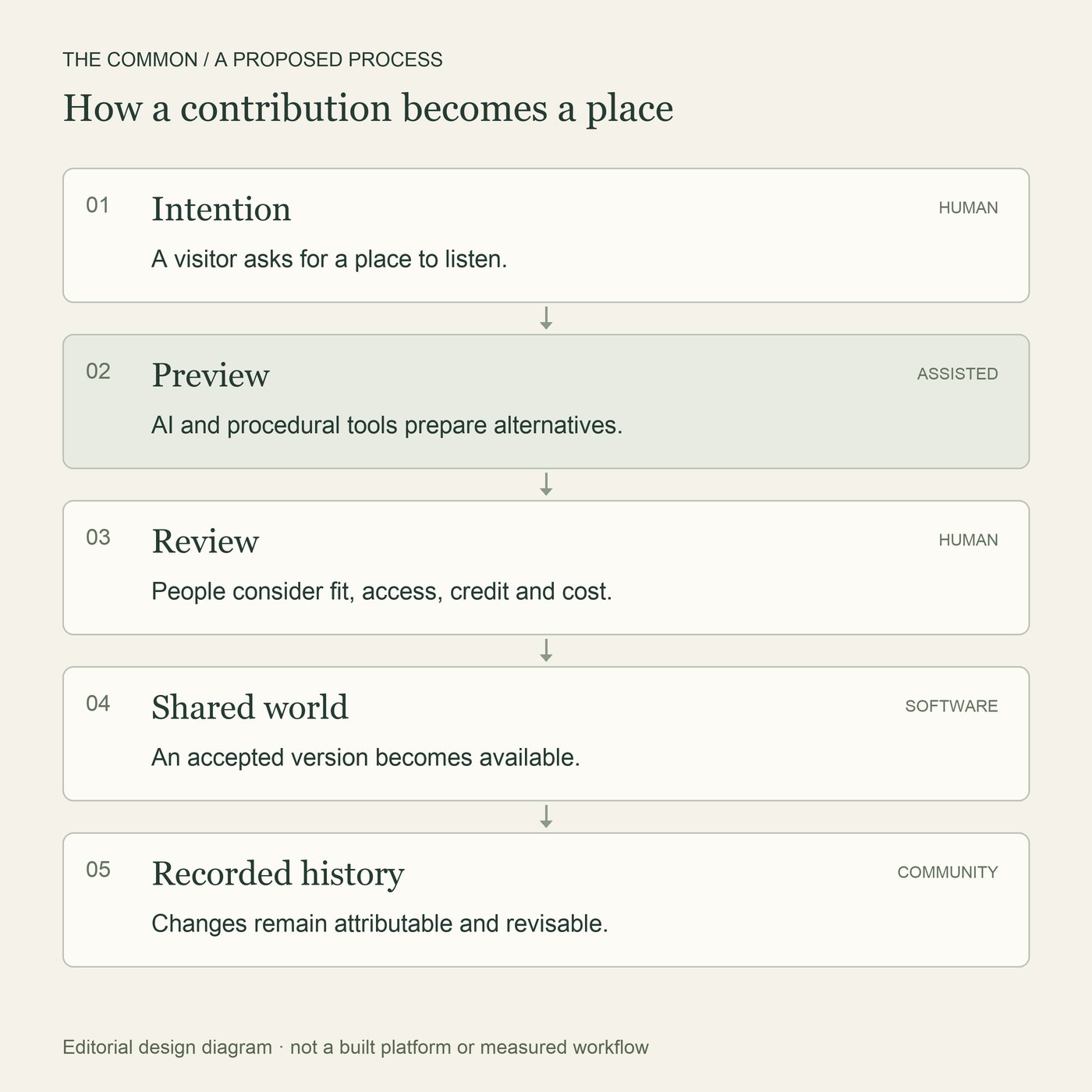
The listening pavilion offers a concrete test of the proposed system. The request begins as an intention, with constraints the contributor can understand: a location, a purpose, a scale, perhaps a preferred material. AI could help clarify the request and prepare alternatives. It should also indicate when a request exceeds the available building vocabulary.
The proposal would first exist in a private preview. Automated checks would examine matters the system can actually measure: blocked routes, object counts, file sizes, missing descriptions and prohibited operations. Those checks could catch defined faults; they could not decide whether the pavilion was artistically compelling or socially welcome.
A human review would then address its relationship to the garden and to the people using it. An accepted version would receive a stable identity, recorded credit and a history of revisions. A declined proposal would remain available to its author with an explanation and a route to revision. The process would need to be light enough that contributing did not become an unpaid administrative job.
Follow a contribution
What happens to an idea?
Open each stage of this proposed process.
01Someone asks
“A shady place to listen near the garden.”
A human intention starts the process. A story, sketch or recording can count as a contribution.
02An alternative takes shape
AI helps assemble a private preview from a bounded vocabulary. Its footprint, materials and route can be inspected and revised.
Private preview03People decide together
Defined checks catch technical faults. Human review considers the garden, its users and whether the addition belongs. A declined proposal can be revised.
Review before acceptance04The world remembers
An accepted pavilion receives a stable identity, credit and revision history. Returning visitors meet the shared version, with room to propose another change.
Accepted version + recorded creditSee the complete contribution diagram
Conflicts would need practical treatment. If two people edited the same roof, the second change could be held as a proposal against the current version, with a visible comparison. Destructive changes to a shared location could require additional review. A version history could make recovery possible, although recovery itself would remain a consequential decision when later contributions depend on what is being reversed.
The system would admit content and parameters through a bounded interface. It would not give every generated script permission to execute on the live server. This is an implementation choice that preserves a clear boundary between suggesting a world change and controlling the application that hosts it.
The world’s memory is a public institution
A shared world needs several kinds of memory. They should be connected carefully.
| Kind of memory | What it preserves | What it must not be mistaken for |
|---|---|---|
| Current state | What exists now, its accepted version and who may change it | A complete account of why it matters |
| Contribution record | Attributed changes, decisions and relevant permissions | A licence to record every private conversation |
| Lived interpretation | Stories, recollections, disagreements and attachments | The authority to silently alter state or credit |
This distinction becomes especially important around AI characters. Joon Sung Park and colleagues’ Generative Agents study placed 25 computational agents in a small sandbox, combining stored observations with retrieval, reflection and planning. The agents demonstrated coordinated behaviour during a short evaluation, including the spread of invitations to a party. The researchers also documented failures of retrieval and fabricated additions to memory. The study investigated believable agent behaviour, not the successful maintenance of a long-lived human community.11
In The Common, an artificial guide could help a visitor find an event or explain an object using approved information. It should be identifiable as artificial. Its account of a pavilion’s history would need to point back to the contribution record. If it became confused, the confusion should not rewrite who made the pavilion or which version was accepted.
Human recollection would have more freedom. Two visitors might remember the same gathering differently. An object could accumulate stories that disagree. A world can preserve factual attribution while allowing interpretation to remain unsettled. That capacity is culturally richer than a single automated narrator claiming to speak for everyone.
Calling the record a public institution is an argument about its function. It allocates recognition, makes decisions inspectable and helps people challenge errors. “Public” here means accountable to the relevant community; private messages and sensitive personal information would not become communal property. Decisions about retention, visibility and removal would form part of the world’s design.
Open source needs an open door
An invitation to visit or upload material does not make a project open source. The Open Source Initiative’s definition concerns software permissions, including access to source, modification and redistribution. Those permissions do not automatically apply to every artwork, recording or model used by an application.12
The Common would need an explicit separation between its software and its contributed cultural material. Application code and building tools could use a recognised open-source licence. Assets would carry their own permissions and provenance, with contributors agreeing to a clearly described form of reuse. A proprietary generation service could remain an optional tool, provided the world could operate without it and its outputs were used under appropriate terms.
Practical openness would also require documentation that another group could follow: how to run a server, restore a backup, load a world snapshot and understand the data format. Exportable geometry alone would leave behind relationships, permissions and histories. A meaningful export would need to explain which of those can travel, and protect information that should not.
The ability to copy the software and develop a different version would be valuable. It would not guarantee continuity of a community. Relationships and shared commitments cannot simply be transferred with a folder. A project that promised permanent survival because its code was published would be confusing an available resource with the labour required to use it.
Elinor Ostrom’s work on collective governance offers a more demanding vocabulary. Her account of durable cooperation emphasises arrangements suited to particular circumstances, participation in rule-making, accountable monitoring and accessible ways to resolve conflicts. Her research does not establish that virtual worlds behave like the resource systems she studied. It provides questions to ask, rather than a ready-made constitution.13
For this proposal, those questions concern who can accept a contribution, how maintainers are selected, how a decision can be appealed and what happens when the founder stops participating. A published source repository can coexist with highly concentrated authority. If decisions remain concentrated at the beginning, the project should say so, define their scope and make the route towards broader participation concrete.
Welcoming someone who does not play games
The invitation to non-gamers must be visible in the interface. It cannot depend on visitors overcoming controls designed around prior gaming experience. Nor is a browser link, by itself, evidence of accessibility.
The W3C’s XR Accessibility User Requirements identifies needs that include alternative inputs, customisation, orientation aids, direct navigation and alternatives for sensory information. It is a Working Group Note, not a conformance certificate. Its relevance is the breadth of needs an immersive environment must consider.14
The Common would offer a list of places as well as a spatial map, keyboard operation, clear landmarks, captions and descriptions, adjustable movement and a direct way to reach a gathering. A companion text interface would support meaningful actions: inspecting the pavilion, reading its history, suggesting a change and joining the discussion. It would require its own careful design and testing with disabled participants; placing a text panel beside a 3D view would not complete that work.
Optional immersion is a useful design commitment. A headset could eventually provide another way to enter, while the social life of the world remained available through an ordinary screen. Someone should be able to pause, orient themselves or leave an interaction without losing their place in the community.
The same principle applies to authorship. A person should be able to contribute a sentence without writing a perfect prompt, understand what the system has proposed and revise it without accepting the first result. Assistance is valuable when it leaves someone with more control over what they mean.
What the world would cost to keep
The Common would incur several kinds of cost: development and creative work; hosting, storage and delivery; generation; maintenance; and the time spent welcoming people and reviewing changes. A numerical budget would require decisions about devices, asset weight, concurrent visitors, model providers and the frequency of generation. No credible total follows from the concept alone.
A first version could limit those costs by generating additions in batches, reusing approved assets and keeping the live world independent of continuous model calls. It could also begin with scheduled gatherings and a bounded contribution queue. These are strategies to test, not guarantees of inexpensive operation. Human review may become the limiting resource even when generation is fast.
Funding should be examined alongside participation. Grants, memberships or institutional partnerships might support the place, but each would bring expectations. A claim of openness would need to survive ordinary questions: which activities remain available without payment, whether paid supporters gain authority over shared space, and who is compensated for keeping it usable.
There is also a less visible economy of attention. A generator can produce more proposals than a community can consider. Filling every empty corner may remove the room in which a future contribution could matter. Restraint would be part of the creative work: deciding when an addition enriches the place, when it repeats what is already there and when leaving something unresolved is more generous.
An experiment that could change its mind
A first study should be small enough to reveal failure. A proposed pilot might run for four weeks with twelve to twenty invited adults, including people who seldom play games and participants with differing access needs. Those numbers describe a possible research scope, not tested server capacity or a representative sample. Participation, interviews and any recording would require a clear account of consent and data use.
The pilot would begin with the same small settlement and a limited set of contribution types. Recurring hosted sessions would give people a dependable opportunity to meet. Between sessions, participants could revisit the world and make proposals asynchronously. Researchers would document technical faults and the human work required to resolve them, alongside participants’ accounts of their experience.
| Question | Evidence to collect | A reason to revise the design |
|---|---|---|
| Can newcomers act on an intention? | Task attempts, requests for help and interviews | The interface repeatedly requires an experienced intermediary |
| Do accepted changes endure? | Saved versions, reconnect checks and restoration exercises | Visitors encounter contradictory or missing versions |
| Is authorship understandable? | Participants identify contributions and their histories | Credit becomes confused or assistance obscures human decisions |
| Does the place support encounter? | Consented observations and accounts of gatherings | Activities remain isolated despite the shared setting |
| Is maintenance sustainable? | Review time, operating costs and unresolved issues | New additions create more obligations than the group can meet |
An additional comparison could examine a simple component editor alongside AI-assisted proposal-making. It would ask where the assistance helps, where it adds friction and whether participants can still recognise their intentions in the result. A small pilot could identify problems and generate better questions. It could not demonstrate universal belonging or establish the causes of long-term return.
Return itself would need interpretation. People might come back from curiosity, friendship, obligation or affection for a contribution. Time spent online would not settle which explanation applied. The research would need to listen to people who left, including those for whom the place never became comfortable.
Leaving room for someone else
The pavilion at the beginning of this essay remains imaginary. Much of the infrastructure needed to attempt it already has identifiable precedents: procedural tools, language-guided modelling, browser rendering, multiplayer synchronisation and versioned records. Their combination still requires substantial design and engineering. More uncertain is whether the resulting invitation would be understood, valued and maintained by the people it hopes to welcome.
That uncertainty is where the artistic project begins. A world is composed through decisions about what can happen, what can change and what deserves to be carried forward. AI expands the material available to those decisions. It also makes the quality of attention around them more consequential.
For an artist-led practice such as RuneWeb, the possibility is a shared place with a recognisable sensibility and enough openness for other people to alter its future. The first meaningful achievement might be very small: someone returns, finds that a contribution has survived, notices what another person has added and feels able to respond.
The tree is still there. The pavilion has changed a little. There is room beside it for something nobody has proposed yet.
Footnotes and references
- Pavel Curtis, “Mudding: Social Phenomena in Text-Based Virtual Realities,” Stanford HCI seminar, 8 January 1992. Contemporary seminar abstract. Cited for the description of a text-based, multi-participant, user-extensible environment, not as evidence for later governance events. ↩
- Constance A. Steinkuehler and Dmitri Williams, “Where Everybody Knows Your (Screen) Name: Online Games as ‘Third Places’,” Journal of Computer-Mediated Communication 11, no. 4 (2006): 885–909. Journal article. Findings concern the games and communities studied; the small-settlement proposal is this essay’s inference. ↩
- Alexander Raistrick et al., “Infinite Photorealistic Worlds Using Procedural Generation,” Proceedings of CVPR (2023): 12630–12641. Published paper and supporting material. Infinigen is research infrastructure for procedural scenes and synthetic data, not a browser multiplayer platform. ↩
- Gillian Smith, Jim Whitehead and Michael Mateas, “Tanagra: An Intelligent Level Design Assistant for 2D Platformers,” Proceedings of the AAAI Conference on Artificial Intelligence and Interactive Digital Entertainment 6, no. 1 (2010): 223–224. Paper record. DOI: 10.1609/aiide.v6i1.12379. ↩
- Chunyi Sun et al., “3D-GPT: Procedural 3D Modeling with Large Language Models,” first submitted 19 October 2023, revised version 29 May 2024. Full research paper. The demonstrated system works through prepared procedural tools; the reviewed contribution process described here is a separate design proposition. ↩
- Jack Parker-Holder and Shlomi Fruchter, “Genie 3: A New Frontier for World Models,” Google DeepMind, 5 August 2025. Research announcement and stated limitations. Capabilities are attributed to the announcing team and bounded to this dated account. ↩
- World Labs, “Marble: A Multimodal World Model,” 12 November 2025. Technical announcement, particularly the sections on composition, export and future interactivity. Vendor documentation establishes the described features; it is not independent performance testing. ↩
- Ziqi Cai et al., “MASS: Multiplayer World Models with Authoritative Shared State,” arXiv preprint, first submitted 6 August 2026. Paper record and full text of version 1. Its matched Snake benchmark and separate larger simulations do not demonstrate a deployed, richly interactive 3D community. ↩
- Colyseus, State Synchronisation, Persistence and source repository, accessed 7 October 2026. A framework supplies infrastructure; a particular world still needs its own permissions, data model, operating procedures and recovery tests. ↩
- Spark, Technical Overview, accessed 7 October 2026. Browser rendering capabilities do not establish performance or accessibility for a particular implementation. ↩
- Joon Sung Park, Joseph C. O’Brien, Carrie J. Cai, Meredith Ringel Morris, Percy Liang and Michael S. Bernstein, “Generative Agents: Interactive Simulacra of Human Behavior,” Proceedings of UIST (2023). Full research paper. DOI: 10.1145/3586183.3606763. The study’s architecture, short evaluation and reported memory failures inform the distinction between agent recollection and authoritative world records. ↩
- Open Source Initiative, The Open Source Definition, version 1.9, accessed 7 October 2026. This definition concerns software distribution rights; the article’s proposed arrangements for assets and governance require separate decisions. ↩
- Elinor Ostrom, “Beyond Markets and States: Polycentric Governance of Complex Economic Systems,” American Economic Review 100, no. 3 (2010): 641–672. Publisher record and DOI. The institutional questions are applied here by analogy, not as an empirical finding about AI-assisted online worlds. ↩
- W3C, XR Accessibility User Requirements, Working Group Note, 25 August 2021. Full document. This is an exploratory account of user needs, not a conformance standard. All proposed accessibility features would require implementation and testing with relevant users. ↩