At Frieze London, a giant spider offered visitors somewhere to sit. On screen, another spider gave them a reason to leave. Theo Triantafyllidis’s Feral Metaverse (Spider) (2026) connected a climbable sculpture to a cooperative video game in which players worked together to escape an arachnid threat. The arrangement was absurd, but the problem it posed was familiar to anyone who has played with strangers: how do you get people to work together when nobody quite knows what everyone else is doing? 1
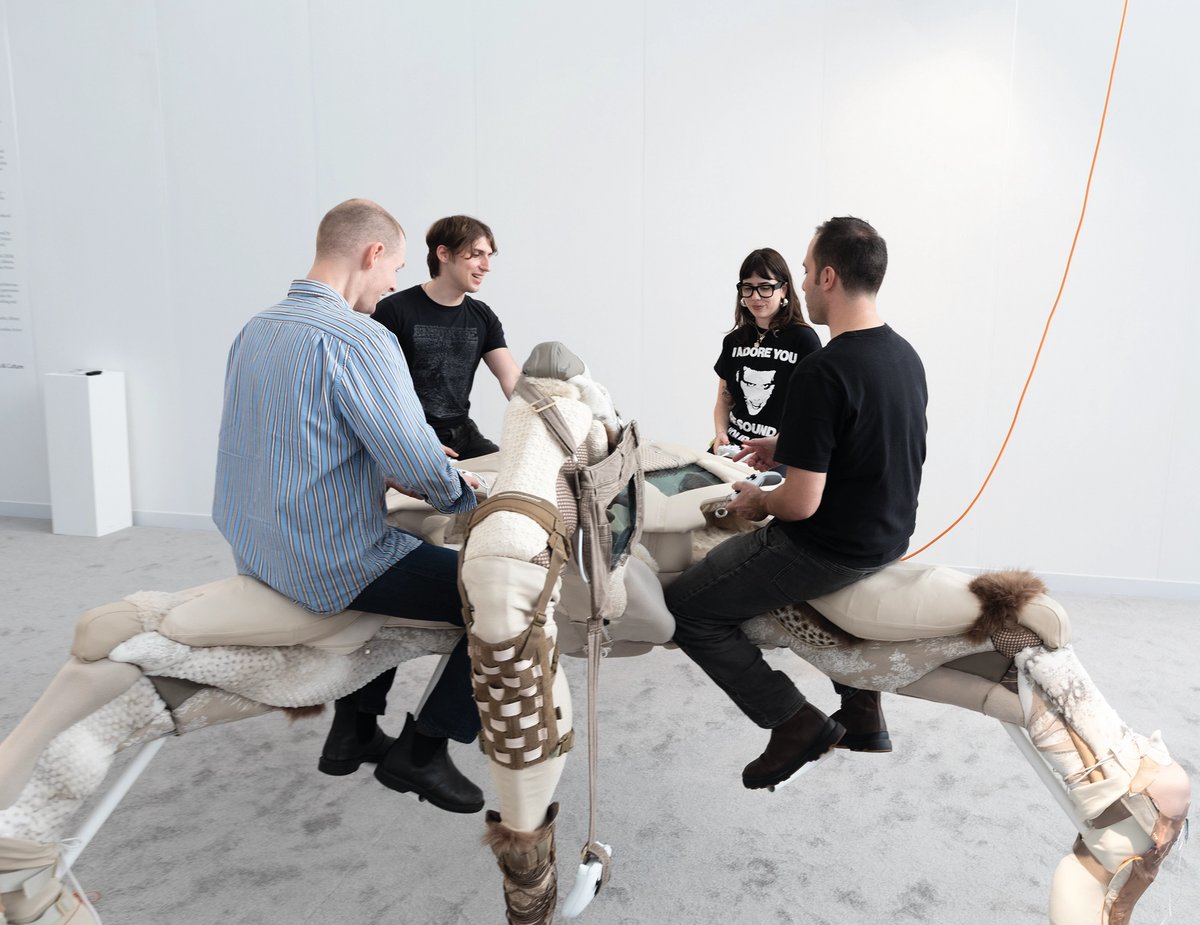
Created for the 2026 Frieze London Artist Award, the installation extended Triantafyllidis’s ongoing Feral Metaverse project. Its physical structure invited visitors to climb aboard and enter a shared digital environment. The commission’s stated ambitions included cooperation, vulnerability and care. Those are substantial claims for a game at an art fair, and the most useful way to examine them is through what the game asks its players to do. 2
In the Frieze iteration, characters climb onto one another’s shoulders, building a precarious tower towards a trapeze near the roof of a cave while avoiding a giant spider’s webs. Escape requires coordination. A player’s ability to move successfully depends on the bodies supporting them and on the people controlling those bodies. Individual competence has to become useful to the group. 3
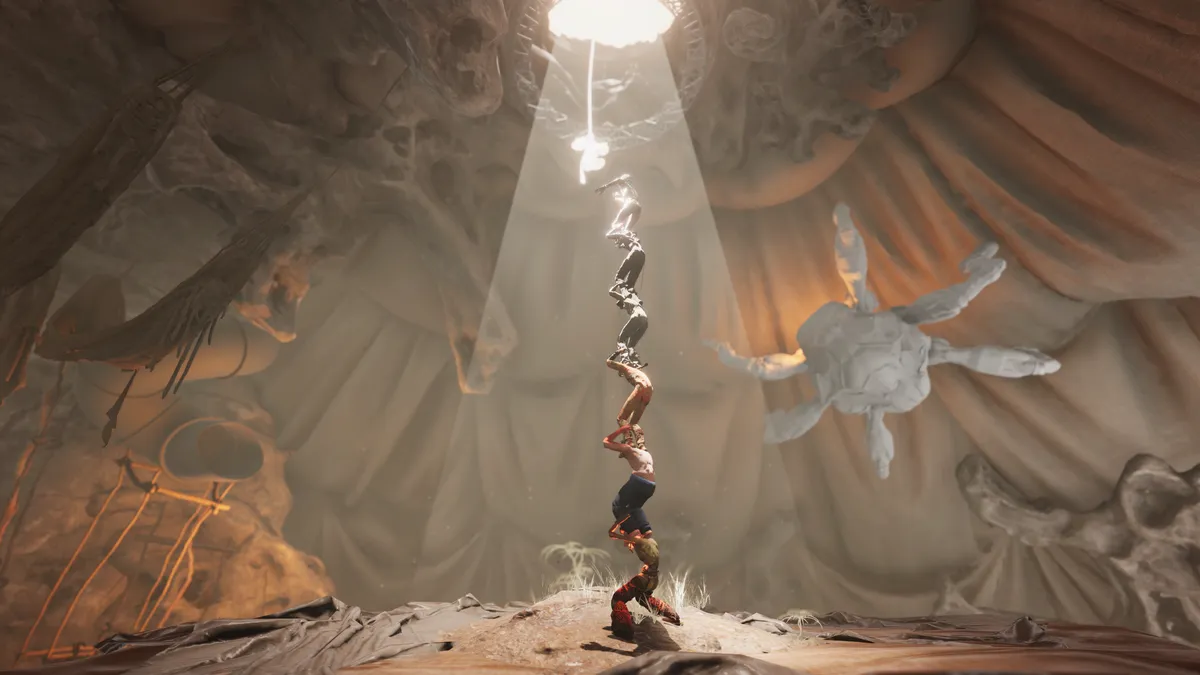
That dependence gives the work its strongest idea. Helping another player becomes part of how progress happens. Someone else’s difficulty enters your own experience directly: their uncertainty affects your movement, their mistake can interrupt your attempt, and their understanding can make a route possible. The game gives cooperation a practical cost. It takes attention, and sometimes patience, to keep another person involved.
For anyone familiar with multiplayer games, this will hardly sound unprecedented. Shared objectives and complementary abilities have structured cooperative play for decades. The work’s interest lies in what happens when these relationships are placed inside an art installation. A familiar gaming problem becomes a way of examining how an audience forms, who takes responsibility for others and how much participation an artwork can reasonably demand.
The sculpture matters to that experiment. Its soft, climbable form makes bodily contact part of the invitation to play. Players occupy the same physical space as they negotiate the digital one; the work asks them to watch one another, exchange advice and learn together. 4 The resulting encounter potentially extends beyond the controller. Explaining a movement to someone beside you involves a different kind of exposure from issuing instructions through an online chat. Your hesitation, impatience or willingness to help becomes visible.
Frieze gives that visibility a particular context. An art fair organises encounters around objects that can be viewed, discussed and acquired. A multiplayer installation introduces a further demand: stay long enough to become useful to someone else. The visitor has to commit time without knowing whether the group will succeed. Attention becomes a contribution to an activity whose outcome nobody controls individually.
It would be easy to describe this as a temporary escape from the fair’s hierarchies. That would overlook the hierarchies games bring with them. Familiarity with a controller, confidence in giving instructions and comfort performing in public can all shape who leads. A newcomer may depend heavily on a more experienced player. The meaningful question is how that experience gets used. Does expertise create room for someone else to learn, or does the group become organised around its most impatient member?
This is where the language of care needs scrutiny. Requiring people to cooperate does not determine how they will treat one another. A shared objective can encourage generosity, but it can also make the struggling player seem like an obstacle. Anyone who has been blamed for a failed team attempt knows how quickly collective dependence can become collective irritation.
The distinction matters because the installation’s social claims cannot be settled by its rules alone. To assess them, we would need to consider what happens between players: whether they explain rather than simply command, whether mistakes remain tolerable, and whether somebody who initially struggles gets another chance. Completing a task together offers limited evidence of care. Making room for another person’s learning would tell us more.
The conditions supporting this experiment also deserve attention. The commission was co-produced by Frieze and Forma in collaboration with Google Arts & Culture. According to Google’s account, Triantafyllidis’s team used Gemini to develop sketches, character designs, backdrops and 3D renders. Its vision of shared digital experience was therefore realised with corporate support and proprietary tools. 4
That relationship creates a question about where the work’s proposition ends. Cooperation within a game concerns how participants act under its rules. A digital commons would also involve questions about who controls those rules, who can access the space and who keeps it running. The installation can explore the first set of relationships without resolving the second. Its sponsorship makes that distinction especially relevant.
Feral Metaverse is most persuasive when approached as a bounded experiment in dependence. It gives players a reason to notice one another and makes their ability to proceed contingent on a shared effort. What they do with that dependence remains open. The rules can require a tower of bodies; they cannot guarantee patience between the people controlling them.
At an art fair, that is a worthwhile demand to introduce. For a brief encounter, another person’s progress becomes part of your own. The work’s social promise rests on whether players come to regard that dependence as more than an inconvenience on the way to winning.
Sources & references
- Phin Jennings, “Frieze Artist Award winner Theo Triantafyllidis’s spider sculpture aims to bring people together”The Art Newspaper, 14 October 2026. Installation and gameplay overview.
- “Frieze London Artist Award 2026: Theo Triantafyllidis to Create Participatory Sculpture Installation”Frieze, 7 July 2026. Commission announcement and stated artistic ambitions.
- “Theo Triantafyllidis: the absurdist artist taking on the tech titans”Financial Times, 8 October 2026. Artist interview and description of the cooperative escape mechanics.
- Eva Langret and Amit Sood, “Meet the artist who built a giant spider for a virtual world”Google, 6 October 2026. Project collaboration, physical interaction and Gemini’s role in the design process.